The Adoptee Lifespan Framework
A theoretical framework for understanding adult adoptee experience.
Developed by Renée M. Murphy.
Antioch University New England.
About the Framework
Being adopted remains part of who a person is in adulthood, shaping how they see themselves, their relationships, and their place in the world. Most of the time this sits in the background of an ordinary life, and clinicians rarely ask about adoption because nothing points them there.
The central claim of the Adoptee Lifespan Framework is that being adopted is a loss the self forms around, not a wound to heal from. It shapes identity, belonging, and the story a person tells about their life, even while it stays in the background. At certain points, such as becoming a parent, a birthday, or the death of an adoptive parent, being adopted comes forward, and what happens next depends on how much the person can take in and who is around them.
What the framework adds is an account of timing and difference: why being adopted comes forward at one point in a life and not another, and why the same event unsettles one adoptee and not another. It is written for clinicians who have adult adoptees in their practice, whether or not they know it, and its focus is adults from their thirties into later life.
Identity, Belonging, and Story
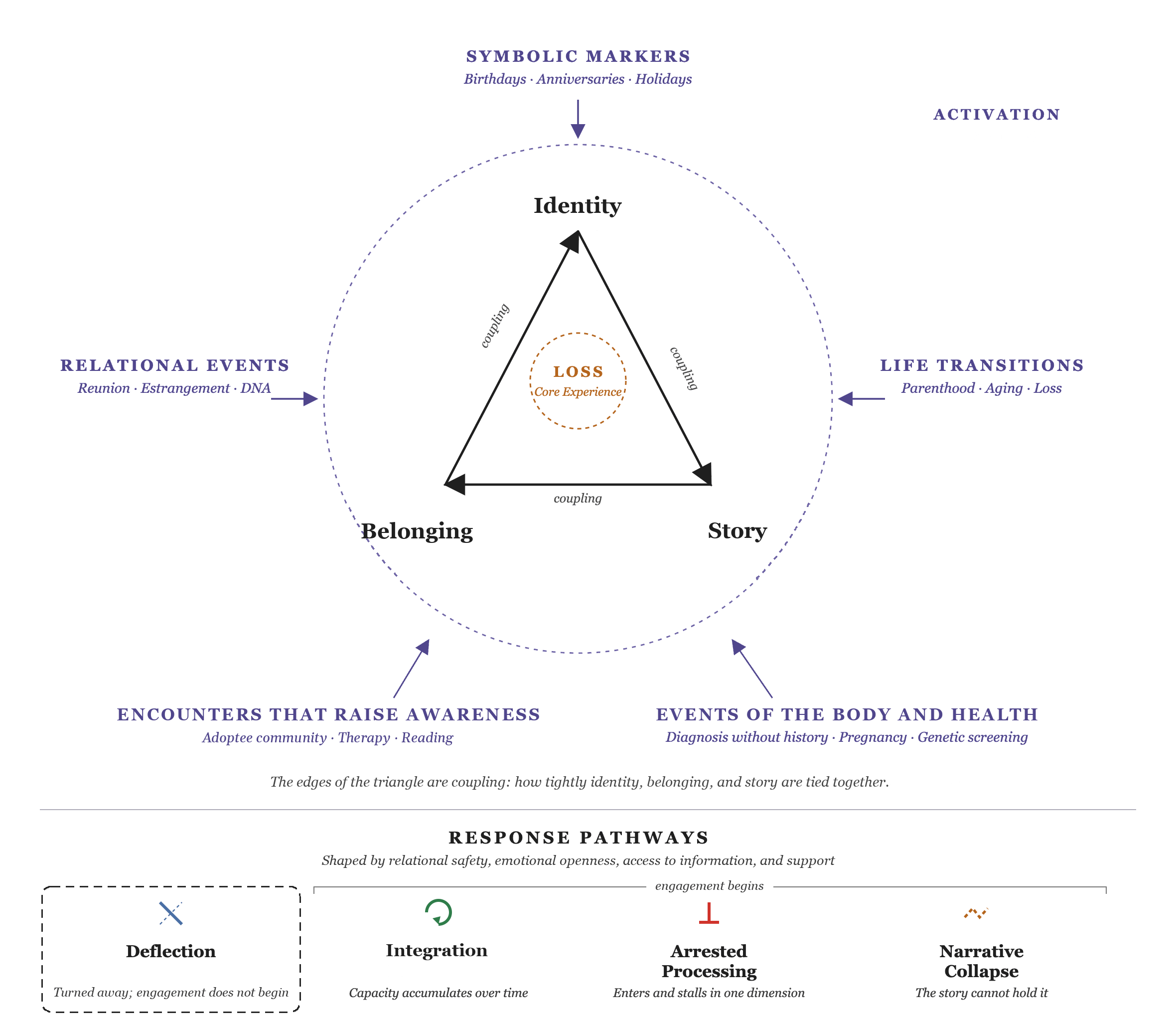
Being adopted shapes how a person thinks of themselves, where they feel they fit in, and how they make sense of their life. The framework calls the conditions a person grows up within as an adoptee the developmental context: the loss itself, and how the family, institutions, and culture around them handle it.
Identity. How a person understands who they are over time. The pull toward origins belongs here, and it does not depend on how good the adoptive family was. A loving family cannot supply the wish to see oneself in the people one came from.
Belonging. Where a person feels they fit in: whether they are seen, accepted, and claimed. Belonging is never finished for anyone. For adoptees, the question often comes without the answer most people start with, that they belong to the family they were born into.
Story. How a person makes sense of their life over time. Adoptees’ stories contain gaps that can be held but not resolved, and story is what holds the other two together.
Loss at the center. Loss is not a fourth dimension. It sits at the center because identity, belonging, and story all form around the same absence: the first family, the first bond, and people who look, think, and act like you. This is a loss, not a wound. When a person’s mother dies, no one calls it a wound; they expect the person to carry it and still live a full life. An adoptee can attach, know love, and be happy in the family that raised them, and the loss is still there. Whether and how it is grieved varies, and an adoptee who reports no grief is not assumed to be hiding it.
The Framework Across a Life
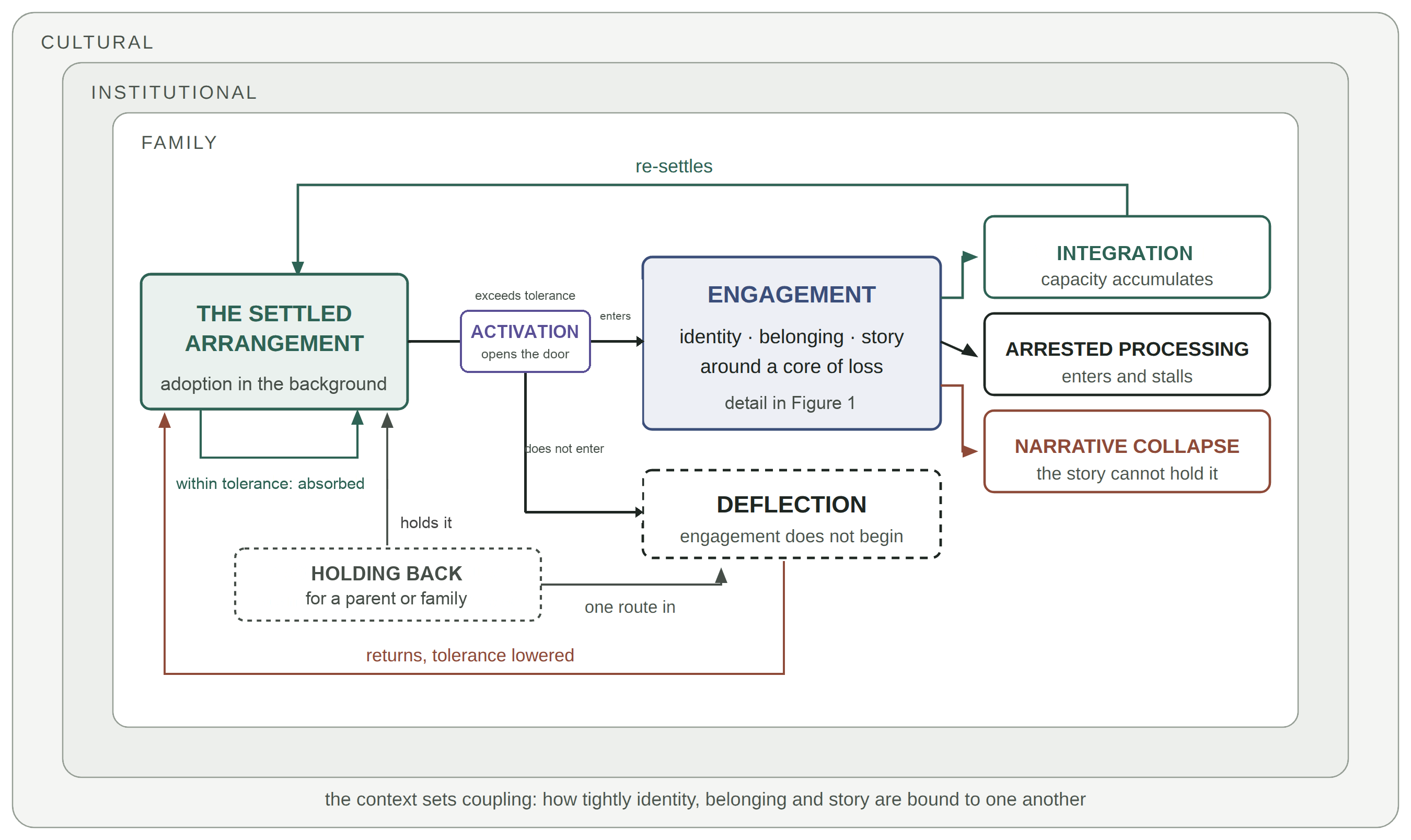
The settled arrangement. Most of adult life is not spent working on adoption. The framework calls this the settled arrangement: a working balance with the facts and losses of being adopted, in which adoption runs in the background. It is ordinary development, neither resolution nor denial. Some settlement is kept for someone else’s sake: an adoptee may hold back from searching, asking, or grieving for a parent or family, and experience it as loyalty.
Activation. Activation is what brings being adopted out of the background: an event, or the lifting of a constraint, that is more than the settled arrangement can absorb. The framework names five kinds: symbolic markers (birthdays, adoption anniversaries, family holidays), life transitions (becoming a parent, a death, aging), relational events (reunion, estrangement, a DNA match), encounters that raise awareness (meeting other adoptees, reading, therapy), and events of the body and health (a diagnosis with no family history, pregnancy).
Activation by release. Being adopted can also come forward when something ends. When an adoptive parent dies, or the adoptee becomes estranged from them, the person may no longer need to hold back for that parent’s sake, and may turn toward their origins for the first time. Release can end a settlement kept for a parent’s sake, or it can end a deflection.
Why the Same Event Lands Differently
Tolerance is the limit of a settled arrangement: how much a new fact, a new person, or a feeling with no place in the arrangement can be taken in before being adopted comes forward. It rests on what a person knows about their origins, how secure their belonging feels, and how they have handled similar events before, and it differs by kind of event: an arrangement may hold birthdays easily and give way at a DNA match. It rises with real information and a surer sense of belonging, and it falls each time a person turns away from something that has come up.
Coupling is how tightly identity, belonging, and story are bound to one another. When coupling is loose, a hard fact about origins stays a fact about origins. When it is tight, a question of identity quickly becomes a question of belonging: if I am not who I thought I was, do I still belong here? Coupling is often tightest where adoption could not be raised without hurting someone. The framework holds that it takes shape in adolescence, when the three first come to depend on one another.
Where an Activation Leads
When activation happens, it can go four ways. In three of them the person engages, beginning to work on what has come up in identity, belonging, and story:
- Integration: the person stays with what has come up and comes to understand it, and their relationship to the loss becomes steadier and more flexible over time, without the loss being resolved.
- Arrested processing: the person starts working through it but cannot finish, often circling in one dimension.
- Narrative collapse: the story the person has lived by can no longer hold what has come up, and no new account has yet formed.
In the fourth, engagement does not begin:
- Deflection: the person turns away from it, sometimes out of loyalty to a parent or family, sometimes for their own reasons. This is neither failure nor deficit, and it can be self-protective. But what came up does not go away; it stays underneath, and there is less room for whatever comes next.
All four are possible for the same person at different times, and none is a judgment of the person. Which path someone takes depends mostly on their conditions and the people around them: relational safety, how openly adoption can be discussed, and access to information, along with other trauma in the person’s life and their own temperament.
Scope
The framework centers on adults who were placed as infants in same-race domestic adoptions with non-relatives. Kinship, step-parent, foster-to-adopt, transracial, international, and late-discovery adoptions each change the picture and need their own study. It does not deny trauma: removal from a birth family, neglect, many moves before placement, a late discovery, or a reunion that breaks down can harm a person, and that harm is a second layer over the developmental context, not a replacement for it.
Each claim is offered as a theory to be tested, with stated predictions about what would count against it.
For clinicians, the framework comes down to this: adoption keeps shaping adults, and a clinician can be open and curious about how it lives inside their client.